Babaran: The Art of Texture in Tumang Copper Craft
Discover the traditional hand-hammered textures of Tumang, where every mark, line, and impression becomes part of the character of handmade metalwork.
A sheet of copper can be perfectly smooth, polished, and reflective.
But in the hands of a pandhe — a traditional metal artisan of Tumang — it can become something entirely different.
A series of carefully placed hammer marks can transform a flat metal surface into something organic, tactile, and full of character. In Tumang, this traditional surface treatment is known as babaran.
More than a decorative finish, babaran is a part of the craftsmanship itself. Each strike of the hammer leaves a small variation on the metal, creating a surface that carries the presence of the person who made it.
And because it is handmade, no two pieces are ever exactly the same.
What Is Babaran?
In Tumang, babaran refers to the textured surface created by hammering copper, brass, and other relatively soft metals using traditional tools and techniques.
The process uses specialized hammers and tools associated with the metalworking tradition of Tumang. The knowledge and skills behind this craft have been passed down through generations of artisans.
The hammering can be performed from one side or both sides of the metal, depending on the design and the desired result.
There is also no single type of babaran.
Different hammering patterns produce different visual characters — from organic and irregular surfaces to rhythmic lines and deeper, more pronounced impressions.
In many pieces, several textures can even be combined to create contrast across a single work.
This means that babaran is not simply a finishing option. It becomes part of the design language of the object.
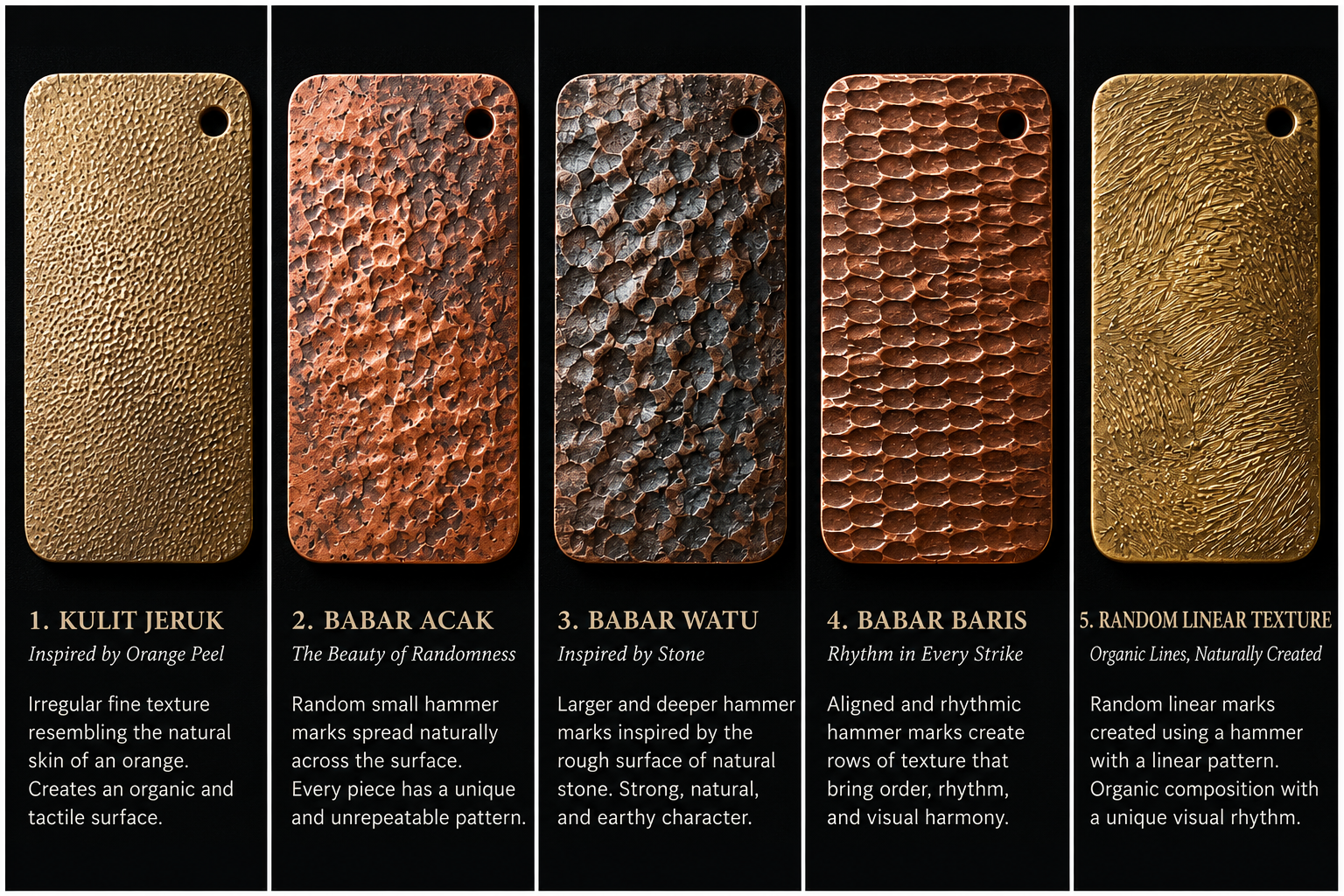
Five Expressions of Babaran
Every babaran has its own character. Some are inspired by nature, while others come from the rhythm and movement of the artisan's hammer.
1. Kulit Jeruk — Inspired by Orange Peel
Kulit Jeruk, literally meaning "orange peel," takes its name from the appearance of its surface.
Its irregular texture resembles the natural skin of an orange, giving a flat metal sheet a more organic and tactile appearance.
The texture is produced through traditional pandhe craftsmanship in Tumang, where the surface is worked by hand using specialized tools.
Rather than looking perfectly uniform, the small variations across the surface contribute to its handmade character.
2. Babar Acak — The Beauty of Randomness
Babar Acak means "random babaran."
The texture is created by striking the metal with a small hammer in an intentionally irregular pattern.
The result is an abstract field of rounded impressions.
Because the marks are made individually and randomly, the exact pattern cannot simply be reproduced. Even when an artisan follows the same general technique, the arrangement of every hammer mark will be slightly different.
This makes Babar Acak particularly interesting for designers looking for a surface with an organic, handmade quality rather than mechanical uniformity.
Every piece carries its own pattern.
3. Babar Watu — Inspired by Stone
Watu means "stone" in Javanese.
As its name suggests, Babar Watu takes inspiration from the rough and irregular character of natural stone.
Compared with Babar Acak, the impressions can appear larger and more pronounced, creating a stronger sense of depth and ruggedness.
This makes the texture particularly suitable for pieces where a more natural, earthy character is desired.
For example, it can complement the solid presence of a sculpture, where the roughness of the surface can reinforce the organic form of the artwork.
4. Babar Baris — Rhythm in Every Hammer Mark
Unlike Babar Acak, Babar Baris is defined by order.
The hammer marks are made in a more aligned and controlled arrangement, creating rows of repeated impressions across the surface.
The result is still unmistakably handmade, but it introduces a stronger sense of rhythm and visual structure.
This makes Babar Baris particularly interesting for architectural and contemporary applications.
On a pendant or chandelier with a Scandinavian-inspired design, for example, the ordered hammered texture can add subtle visual interest while maintaining a clean overall aesthetic.
5. Random Linear Texture
Another variation uses a hammer with a distinctive linear pattern on its striking surface.
The hammer is used randomly across the metal, much like Babar Acak. The difference is in the shape of the mark.
Instead of rounded impressions, the tool leaves small linear marks across the surface.
The randomness creates an organic composition, while the repeated lines introduce a different visual rhythm.
It is another example of how a change in the artisan's tool can fundamentally change the personality of the finished metal surface.
Texture Is Also About Light
One of the most interesting characteristics of babaran becomes visible when the finished piece meets light.
A perfectly flat metal surface reflects light relatively evenly.
A hammered surface does something else.
Every small indentation and raised area changes the direction in which light is reflected. As natural sunlight or artificial lighting moves across the surface, different areas catch the light while others fall into shadow.
The result is a constantly changing interplay of highlights, shadows, and reflections.
This is particularly valuable for architectural objects such as:
- Pendant lights
- Chandeliers
- Wall panels
- Decorative screens
- Sculptures
- Architectural ornaments
- Custom interior elements
For lighting products especially, the texture can become part of the lighting experience itself.
The metal is no longer simply the material surrounding the light source.
The surface becomes part of how the light is perceived.
When Precision Matters: Dot Texture
Not every handmade texture is intentionally random.
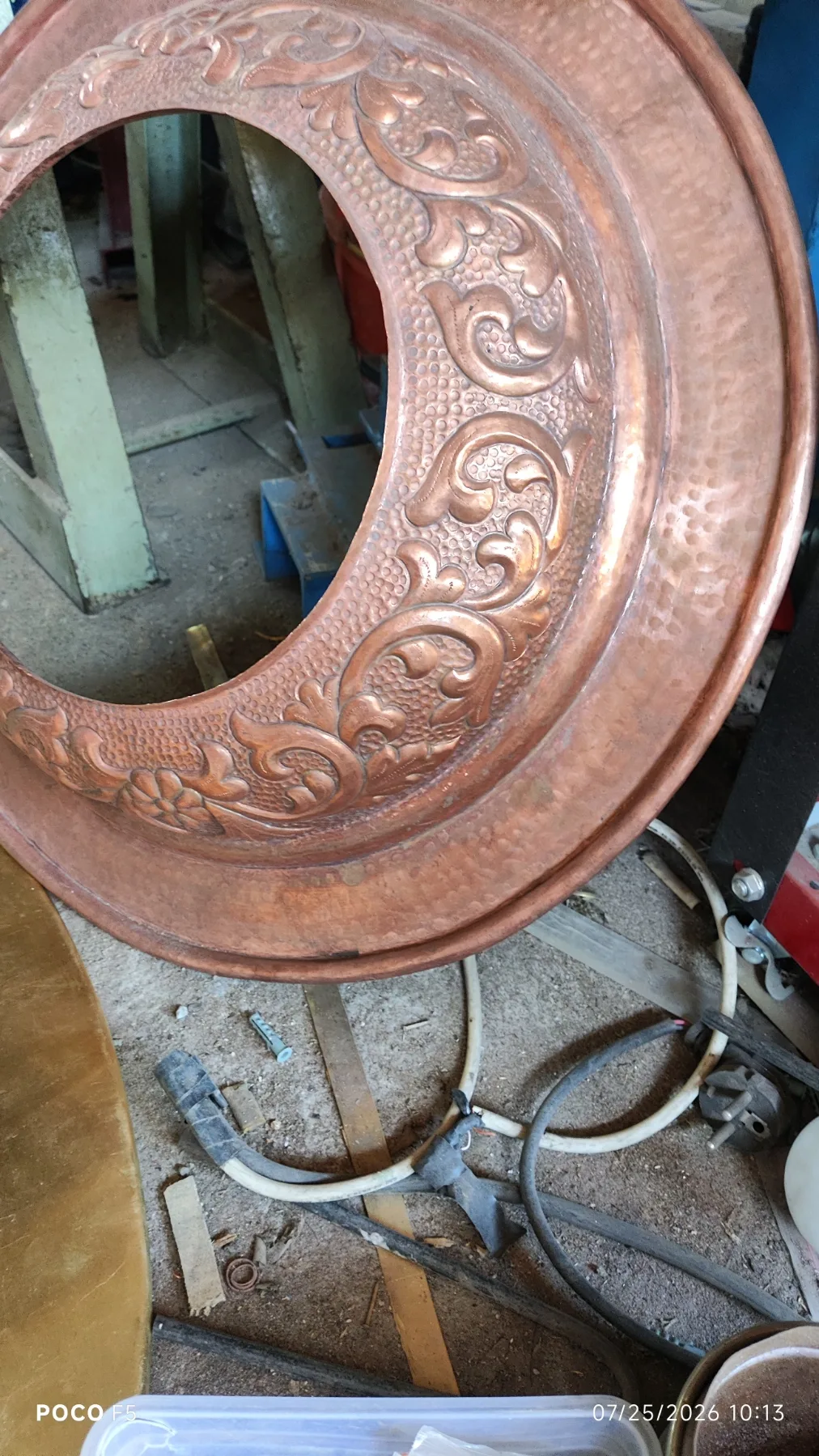
The detail shown in one of our chandelier works is an example of a more controlled approach.
Here, small rounded impressions are arranged in a regular pattern. Each mark needs enough space from the next so that the individual dots remain clearly visible.
If the artisan strikes too close to the previous mark, the impressions can overlap and lose the clean character of the pattern.
This requires a different kind of craftsmanship.
The surface may still be handmade, but the artisan must carefully control the position, spacing, and rhythm of each individual strike.
It is a reminder that handmade does not necessarily mean uncontrolled.
Sometimes, the beauty comes from precision achieved by hand.
One Material, Many Textures
Babaran is not limited to copper.
The technique can also be applied to other relatively soft metals, including brass and aluminium.
However, the material is only one part of the final appearance.
The combination of:
metal + hammer + tool + technique + artisan
determines the final surface.
That is why the same general idea can produce very different results depending on the material, the chosen tool, and the way the artisan works the surface.
Choosing the Right Texture for the Design
At Tumang Copper Works, texture is not treated as a one-size-fits-all finish.
We consider the form, design language, and desired atmosphere of each piece.
A sculpture might benefit from the rough, natural character of Babar Watu.
A contemporary pendant might work better with the ordered rhythm of Babar Baris.
An organic decorative object may call for the randomness of Babar Acak.
And in a custom project, different textures can be combined within the same piece to create contrast and hierarchy.
Designers and clients can request specific textures, and the craftsmanship can be adapted to suit the intended design.
This flexibility is especially important for custom architectural and interior projects, where the surface finish needs to work together with the overall concept rather than simply being added at the end.
The Beauty of Being One of a Kind
Perhaps the most important characteristic of babaran is also the simplest:
It is made by hand.
Every hammer strike is a physical interaction between the artisan, the tool, and the metal.
Even when the same material, tools, and general technique are used, the exact arrangement of marks will naturally vary from one piece to another.
That variation is not a flaw.
It is the point.
A handmade surface carries small imperfections, subtle differences, and traces of the person who created it.
This gives each finished piece its own identity.
One of a kind. Handmade. Timeless.
And most importantly, it carries a distinctly human artistic touch.
A Living Craft Tradition from Tumang
The knowledge behind Tumang's metal craft is more than a production technique.
It is a tradition that has been passed from one generation of artisans to another.
The Seni Kriya Logam Tumang has been recognized by Indonesia's Ministry of Education, Culture, Research, and Technology as part of Indonesia's Intangible Cultural Heritage (Warisan Budaya Takbenda).
For us, this recognition represents something important: the value of preserving not only the objects produced by Tumang artisans, but also the knowledge, skills, tools, and craftsmanship behind them.
Every hammered surface is therefore connected to a much longer story.
A story of metalworking in Tumang.
A story passed from hand to hand.
And a story that continues to evolve through contemporary design.
From Traditional Craft to Contemporary Design
Today, babaran can be found across a wide range of custom metalwork — from traditional decorative pieces to contemporary chandeliers, lighting, sculptures, and architectural elements.
The tools and knowledge may come from generations of craftsmanship.
The designs, however, can continue to evolve.
This combination of traditional technique and contemporary design is what makes Tumang metalwork particularly interesting for architects, interior designers, and hospitality projects.
A modern chandelier can carry a traditional craft heritage.
A minimalist wall panel can still bear the marks of a traditional hammer.
And a contemporary sculpture can preserve the tactile character of handmade metalwork.
That is the role of babaran: connecting the past with the way we design spaces today.
Designed by You. Crafted by Hand.
At Tumang Copper Works, we believe that the surface of a metalwork should be more than a finish.
It should contribute to the identity of the piece.
Whether you are looking for the organic character of Babar Acak, the rugged texture of Babar Watu, the rhythmic pattern of Babar Baris, or a custom combination developed specifically for your design, our artisans can adapt traditional Tumang craftsmanship to your project.
Every strike leaves a mark. Every mark becomes part of the story.